In April 2025, Duolingo CEO Luis von Ahn wrote to employees: “Duolingo is going to be AI-first.” The same memo said Duolingo would “gradually stop using contractors to do work that AI can handle” and grant headcount only when a team could not “automate more of their work.” Shopify described Tobi Lütke’s internal memo with a similar rule: “reflexive AI usage is now a baseline expectation at Shopify.”1
In February 2026, Block announced that it would cut its workforce from more than 10,000 people to fewer than 6,000. Jack Dorsey told shareholders: “A significantly smaller team, using the tools we’re building, can do more and do it better.” In May, Coinbase cut about 14 percent of its staff while citing both a down market and AI, then told the remaining employees that the company needed AI “across every facet of our jobs.” Two days later, Cloudflare announced 1,100 cuts as part of an “agentic AI-first operating model.”2
Von Ahn later reversed the performance rule. In April 2026, he said Duolingo had backed away from rating employees on AI use because “we’re trying to just push something that in some cases did not fit.” The company returned to judging whether people did their jobs well, whether or not AI helped.3
Leaders use these statements to set operating rules for budgets, hiring, performance reviews, contractor use, and product scope. Employees read them as instructions about their own jobs.
Once leadership says AI-first, finance looks for cost cuts; the board looks for evidence that management is not falling behind; technology teams inherit architecture, data, and governance work; product teams are expected to add features; HR turns the promise into workforce plans; employees wonder whether their jobs are the savings target.
Companies can copy the word AI into memos, dashboards, OKRs, board decks, layoff stories, and LLM outputs faster than they can fit the technology into real work.
Leaders often promise AI-first results before their firms have built the infrastructure, expertise, governance, and workflows needed to deliver them.
A usable strategy has to name the mechanism: this model, with this data, inside this workflow, changes this behavior, creating this value, with these risks. That sentence is harder to repeat than AI-first.
AI may be a general purpose technology. It may eventually change knowledge work the way electricity changed factories and computing changed offices. The economic case is real enough to take seriously: LLMs are broadly applicable, improve quickly, and can spawn downstream tools and workflows.4 Inside firms, though, people already use the word AI as a general purpose token.
The organizational failure is older than AI. Companies have run the same pattern through digital transformation, agile, cloud, data-driven, customer obsession, outsourcing, and cost discipline: an executive category, visible artifact, or proxy measure stands in for evidence that the work improved. AI is the current token, not the source of the habit.
Key terms
These labels keep the steps of the chain separate. They are not rival definitions of AI.
- GPT-tech — general purpose technology in the economic sense: broadly applicable, continuously improving, and generative of complementary innovations. The label distinguishes this meaning from the transformer architecture acronym.
- LLM — Large Language Model: the model that processes and generates language.
- model-token — computational unit an LLM processes or generates.
- sign-token — compact cultural sign people and models can copy:
AI,platform,innovation,transformation,data-driven,AI-first. - token variant — a copy of the sign changed to fit an audience, format, or incentive.
- strategy-token — sign-token variant managers embed in organizational rules and decisions: OKRs, dashboards, budgets, roadmaps, job titles, reorgs, rituals, vendor categories, performance reviews, and layoff narratives.
- AI-token — strategy-token version of
AIwhen it stands in for the future, intelligence, efficiency, innovation, risk, transformation, inevitability, cost discipline, or workforce rationale. - selfish token — sign selected for ease of replication even as it loses the mechanism it once named.
Selfishis analytical, not moralizing. - token host — person, group, or model that stores, repeats, or modifies the token. A host need not believe the claim.
- selection pressure — property of a channel or incentive that makes one variant easier, safer, or more rewarding to repeat than another.
- token phenotype — visible effect of repetition: posts, memos, dashboards, benchmarks, layoffs, job titles, policies, rebuttals, rituals, and changed work.
How the token spreads
A language model works with tokens: fragments of text. People inside a company work with another kind of token: a short phrase they can copy into a memo, dashboard, job title, budget request, vendor pitch, or layoff story.
An LLM generates text. People turn that text into memos, posts, policy drafts, strategy decks, product copy, risk frameworks, governance language, investment theses, skeptical essays, and layoff rationales. Some of those artifacts make a phrase like AI-first easier to copy.
People and models copy the sign, and each repetition can produce a variant. Channels and incentives select the variants that fit. Managers retain selected variants in hiring rules, roadmap changes, procurement categories, performance reviews, budgets, metrics, and cost-cutting stories. People then have to act on them. The token spreads as this cycle repeats. The wording may be copied exactly even as the mechanism disappears.5
The resulting memo, rule, dashboard, or layoff is the token phenotype: the visible result of people acting on the repeated sign.
The capability can be real while companies use the same word to sell it, govern it, mock it, resist it, and justify decisions around it.
The token spreads before the mechanism
A mechanism-oriented AI claim sounds like this:
We believe an AI system can reduce enterprise renewal risk by synthesizing support tickets, usage drops, CRM notes, contract terms, and meeting history into account-specific intervention prompts ninety days before renewal. This creates value only if account managers trust the output, act earlier, and change the renewal conversation before the customer has already decided to churn.
A mechanism-oriented claim names the user, the data, the behavior change, the economic claim, and the ways the plan can fail.
AI-first has a replicative advantage: it drops all of that. It fits in a slide title, memo subject, OKR, dashboard, keynote, budget request, investor answer, or layoff note. An executive, employee, vendor, consultant, or model can repeat it without specifying the workflow.
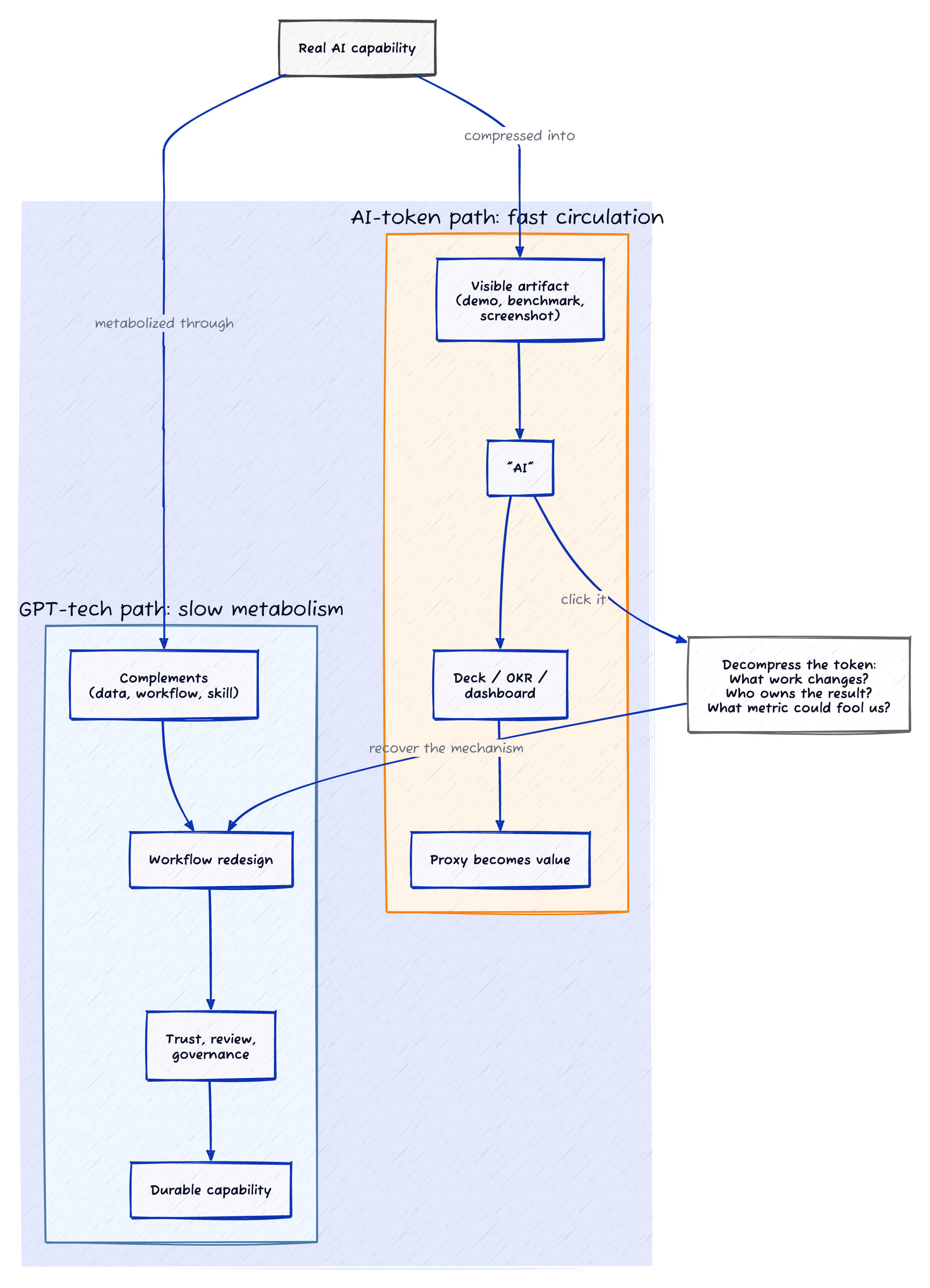
Firms absorb a GPT-tech slowly: they build infrastructure, standards, skills, trust, governance, and new workflows. People and models can repeat the AI-token in feeds, keynotes, demos, dashboards, boardrooms, vendor pitches, and layoff memos before firms understand the underlying mechanism. Executives can then mistake those repeated artifacts for evidence that they have changed the work.
A general purpose technology has to be absorbed. A general purpose token only has to be repeated.
What gets repeated in each channel
The same AI claim varies as people and models repeat it in LinkedIn posts, Twitter/X threads, dashboards, board decks, investor calls, procurement categories, layoff memos, and LLM outputs. People use LinkedIn posts for career signals and Twitter/X threads for fights. Dashboards reduce the claim to a number; board decks to a category; layoff memos to a justification. LLMs reproduce common wording.
People drop the workflow because spelling it out takes more space and requires more evidence. A mechanism-oriented AI claim needs the model, the data, the user, the failure mode, the review path, the integration burden, the operational metric, and the behavior change. AI-first needs two words.
Each channel creates a different selection pressure. People repeat the variant that fits: AI fits the slide title, dashboard, OKR, investor call, LinkedIn post, Twitter/X dunk, vendor category, all-hands theme, layoff memo, and LLM-generated press release; the full workflow does not.
Organizations accept different things as proof in each format.6 A demo can pass for transformation, a benchmark can pass for intelligence, an adoption dashboard can pass for value, a generated artifact can pass for work replacement, and a CEO’s AI-first language can pass for strategy.7
Organizations absorb AI on two clocks.8 The slow work includes memory, apprenticeship, standards, local judgment, governance, trust, and workflow. The fast work includes administration, command, markets, dashboards, feeds, board decks, and procurement categories. A GPT-tech depends on the slow work. People can repeat the AI-token immediately. That is how firms build AI dashboards, governance offices, savings targets, and workforce plans before the work itself has changed.
Some AI talk is participation, not information transfer.9 We are AI-first marks modernity. AI will replace you marks inevitability. AI is slop marks resistance. The claims disagree, but each keeps AI at the center. On LinkedIn and Twitter/X, this becomes call-and-response: AI-first, AI-native, agents are coming, learn AI or be replaced, AI slop, do more with less, the future of work.10
The same structure appears outside corporate management. Policy, regulation, academia, and critical AI communities also produce strategy-tokens: AI safety, alignment, responsible AI, frontier models, open weights, human-centered AI. These terms sometimes name real work and sometimes become category badges. People can repeat these signs and their variants across contemporary media long before anyone has to specify a mechanism.
Once the sign is familiar, people and systems use it to sort firms and workers into future-ready or obsolete, AI-native or legacy, efficient or bloated.11 Managers can then treat the repeated representation as proof of the change: they approve dashboards, governance offices, savings targets, and workforce plans before the work changes.12 LLM interfaces, Slack, PowerPoint, OKR tools, benchmark sites, procurement categories, and LinkedIn make repetition cheap.13 Speed compounds the error: the demo outruns the implementation plan, the benchmark outruns the evaluation culture, and the layoff headline outruns careful attribution.14
How channels select AI variants15
| Channel | Variant rewarded | Detail dropped |
|---|---|---|
| Slide title | Category | Workflow |
| Dashboard | Number | Judgment and review burden |
| Board deck | Strategic narrative | Implementation detail |
| Investor call | Future-facing signal | Causal uncertainty |
| Layoff memo | Justification | Task-level evidence |
| Career signal | Mechanism | |
| Twitter/X | Conflict and affiliation | Nuance |
| LLM output | Familiar phrase | Local context |
Replication into organizational rules
1
2
3
4
5
6
real capability
  -> visible artifact
  -> copied sign
  -> selected variant
  -> retained in metric / target / budget / narrative
  -> changed behavior
The technology is real, and the effects are uneven
The productivity studies below show the real capability that gives the token credibility. LLMs produce measurable gains in some settings, but the evidence shows task-specific mechanisms, not one productivity curve.
Brynjolfsson, Li, and Raymond studied a generative-AI assistant rolled out to customer-support agents and found a roughly 14 percent average productivity gain, with much larger gains for novice and lower-skilled workers.16 Peng, Kalliamvakou, Cihon, and Demirer found that developers using GitHub Copilot completed a bounded JavaScript task 55.8 percent faster than the control group.17 A Google randomized controlled trial found about a 21 percent reduction in task time on a complex enterprise-grade task, while warning that the lab result may not generalize across ecosystems, tools, and time.18
The effect can reverse when the task, developer, and codebase change. METR’s 2025 randomized controlled trial found that experienced open-source developers working in familiar, mature repositories took 19 percent longer when early-2025 AI tools were allowed, even though they expected beforehand that AI would speed them up and believed afterward that it had.19 A later study of open-source projects found that AI-assisted programming increased activity from less-experienced developers but also increased rework and maintenance burden for core developers.20 A 2026 Microsoft-scale study of command-line coding agents found that adopters merged roughly 24 percent more pull requests, while explicitly treating merged PRs as a proxy for output, not final value.21
The unit is not coding; it is a work system. Task type, codebase maturity, developer expertise, review burden, architecture, test coverage, quality bar, organizational context, and error tolerance can turn the same tool into a gain or a drag.
The shorthand claim says:
AI writes code.
To describe the mechanism, we have to ask:
- What part of software engineering got cheaper?
- What burden moved downstream?
- Who reviews the output?
- What does the metric count?
- What has become more important because output is now cheaper?
People repeat the token because it points to real tools and measured gains. The problem starts when firms copy the conclusion without the task, workflow, limits, or review burden that produced it.
- A support productivity gain becomes
white-collar work is ending. - A code-generation demo becomes
engineers are obsolete. - A chatbot pilot becomes
agentic transformation. - A cost-cutting program becomes
AI-enabled restructuring. - A board anxiety becomes
AI strategy.
People do not need the AI-token to be causally precise. They need it to be useful to repeat.
Visible artifacts and hidden work
An AI output shows that a model produced an artifact. It does not show that the work improved or that anyone benefited. Abbott’s Flatland gives a useful image: a sphere passing through a two-dimensional world appears to the Flatlanders as a changing circle: point, widening circle, narrowing circle, point. They see the trace correctly but mistake it for the whole object.22
Organizations see the visible artifact:
1
2
3
4
5
prompt -> code
prompt -> memo
prompt -> slide
prompt -> support response
prompt -> analysis
Then they infer that they have seen the work, when they have often seen only its output. A legal brief, diagnosis, strategy deck, line of code, support response, or generated summary leaves the surrounding judgment and accountability off-screen.
The generator is the work behind the artifact: judgment, context, accountability, tacit knowledge, timing, trust, integration, review, maintenance, customer reality, and consequence.
AI tools and AI rhetoric make code, text, slides, images, and answers appear quickly. Sometimes the apparent efficiency comes from moving work somewhere harder to see, not eliminating it.
The better question is:
What else has to happen for the artifact to produce a useful result, and who is responsible for that work now?
For code, that work includes understanding the system, choosing what should exist, preserving invariants, integrating with other services, reviewing edge cases, maintaining the result, and owning failure. For a support response, it includes customer context, escalation judgment, policy authority, empathy, and trust. For a diagnosis, it includes examination, history, risk tolerance, liability, and follow-up.
AI can remove some of that work. It can also move the work to data preparation, review, exception handling, customers, senior employees, maintenance, security, quality, or trust repair.
When managers say AI instead of engineers, they have mistaken code for engineering.
Engineers produce code, but engineering is not code production. Engineering is the construction and stewardship of working systems under constraints. It includes deciding what should exist, understanding existing systems, preserving invariants, designing abstractions, integrating services, debugging failures, securing boundaries, testing assumptions, migrating data, managing tradeoffs, and remaining accountable when the system breaks.
If model output makes code cheaper while system understanding, review, integration, and accountability become the bottlenecks, AI has not eliminated engineering. It has changed where the engineering labor sits.
LLMs help manufacture AI discourse
Steam, electricity, computers, the internet, blockchain, and the cloud all became symbols of the future as well as tools. LLMs add a reflexive loop by helping write the posts, memos, policy drafts, product pages, and layoff scripts that praise, condemn, regulate, sell, or mock AI. These artifacts disagree while making AI the thing everyone must address.
- A pro-AI post says
AI will transform everything. - An anti-AI post says
AI is destroying work. - A skeptical post says
AI is overhyped. - A governance memo says
AI requires responsible adoption. - A layoff memo says
AI enables us to operate more efficiently. - A vendor white paper says
AI unlocks enterprise value.
Agreement is unnecessary. Each artifact creates another copy and gives another host a chance to repeat or modify it; even an LLM-generated explanation of why AI hype is overblown repeats AI.
The loop is:
1
2
3
4
5
6
7
8
9
LLMs generate model-tokens
  -> model-tokens become discourse artifacts
  -> people and models copy them as sign-tokens
  -> channels and incentives select some variants
  -> managers retain those variants as strategy-tokens
  -> firms treat the AI-token as institutionally necessary
  -> firms generate more AI discourse
  -> LLMs assist that discourse
  -> more AI-token replication
AI as workforce narrative
Companies lay off workers for many reasons: overhiring, margin pressure, failed bets, interest rates, restructuring, outsourcing, capital reallocation, investor demands, automation, management fashion, and genuine technological substitution.
Executives can use AI to package that causal mess into a story that boards and investors know how to reward: the company is reallocating work to the future instead of explaining overhiring, missed bets, or margin pressure.
The story says:
This is not merely cost-cutting. This is transformation.
This is not managerial failure. This is technological inevitability.
This is not weakness. This is discipline.
Some AI-attributed layoffs reflect real automation: roles are being redesigned, tasks are becoming cheaper, and some companies will need fewer people in certain functions.
By mid-2026, Challenger, Gray & Christmas data had AI as a leading employer-cited reason for U.S. job cuts, while commentators continued to dispute how much of that attribution reflected actual substitution versus broader restructuring and cost pressure.23 The distinction changes what the claim proves. Employer-cited reasons are not the same as causal proof.
Even when genuine substitution occurs, the AI-token still compresses the questions that matter: which tasks changed, which workers were affected, what downstream review or maintenance burden appeared, and whether headcount reduced has replaced the value question: did durable capability hold or improve?
A mechanism-oriented layoff claim would say:
These tasks have been automated or compressed; these workflows have been redesigned; this review burden remains; these quality risks are acceptable; these roles are changing; this is the observed productivity effect; these are the costs we expect to appear downstream.
A tokenized layoff claim says:
AI enables us to do more with less.
The detailed claim names tasks, workflows, burdens, and risks. AI enables us to do more with less may be true in a particular case, but it does not provide enough information to know.
The strategy has to name an advantage
A company saying AI is our strategy is like saying electricity is our strategy or software is our strategy: it may identify the technological epoch, but it does not identify an advantage.
A GPT-tech becomes strategic only when a firm finds a specific mechanism of value: a workflow it can redesign, a constraint it can remove, a capability it can compound, a cost structure it can change, a customer experience it can improve, or a defensible learning loop it can build.
AI-first does not tell us whether the company will use AI for product differentiation, support automation, internal knowledge retrieval, decision support, developer productivity, customer self-service, compliance monitoring, personalization, risk detection, labor substitution, data monetization, or investor narrative.
Mechanism questions the slogan avoids
- What specific work changes?
- Whose behavior changes?
- What data is required?
- Who owns that data?
- What is the trust model?
- What must humans review?
- What error rate is acceptable?
- What error would be catastrophic?
- What cost moves downstream?
- What metric would fool us?
- What customer value is created?
- What capability becomes defensible?
- What should we stop doing?
- What would prove the thesis wrong?
Without those answers, AI strategy describes identity: it tells the organization who it is.
1
2
3
4
5
6
We are AI-first.
We are innovative.
We are transforming.
We are data-driven.
We are a platform company.
We are customer-obsessed.
A strategy that can touch reality has to say:
1
2
3
4
5
6
7
8
9
this model
with this data
inside this workflow
used by this role
under this review process
changes this behavior
creating this value
with these risks
and these failure signals
Each format creates a different selection pressure. PowerPoint rewards pillars, symmetry, and executive confidence; OKRs reward measurable nouns; dashboards reward recurring numerical objects; Slack rewards fast recognition; board decks reward coherent narratives; procurement rewards categories; performance reviews reward participation signals; and investor calls reward concise futures. Those formats make identity variants easy to copy. The mechanism still has to survive the data, workflow, review process, and result.
Put the support claim through those formats and watch what drops out:
- Original mechanism: AI can reduce low-complexity support resolution time if it has access to historical tickets, product documentation, account context, escalation rules, and a human review loop; value appears only if repeat contact declines without degrading trust or hiding unresolved customer problems.
- Deck:
AI-powered support transformation. - OKR:
Deflect 30% of tickets with AI. - Dashboard:
AI deflection rate. - All-hands:
AI helps us serve customers faster. - Layoff:
AI enables leaner operations.
At every step, the statement gets easier to repeat and less faithful to the work.
When the AI number becomes the goal
Once AI becomes a dashboard category, its measure can stop describing work and start steering it. Goodhart’s Law is usually summarized as: when a measure becomes a target, it ceases to be a good measure.24
Turn those measures into targets and each can create its own Goodhart trap:
- If
AI adoptionbecomes the target, employees will use AI whether or not it improves work. - If
AI use cases launchedbecomes the target, teams will launch use cases whether or not they change a bottleneck, cost, customer problem, or decision. - If
tickets deflectedbecomes the target, customers may be prevented from reaching humans while unresolved frustration disappears from the dashboard. - If
lines of code generatedbecomes the target, code volume rises while maintainability falls. - If
AI-driven savingsbecomes the target, teams can relabel ordinary cost cuts as AI even when the operating model has not changed.
A target can corrupt behavior and train people to care about the score instead of the goal. C. Thi Nguyen calls this value capture: simplified scores, rankings, or metrics overtake the richer values they were supposed to serve.25
The most literal form is the model-token leaderboard: ranking employees by how many computational tokens their AI tools consume. In April 2026, The Wall Street Journal reported that an internal Meta dashboard ranked employees by individual model-token usage and assigned status titles such as Token Legend. In May 2026, Business Insider reported that Amazon deprecated an informal internal KiroRank leaderboard after it encouraged some employees to perform tasks that did not necessarily solve problems in order to climb the ranking. Indeed’s CIO offered the counterdiscipline: track token use in the background, but keep the visible management system closer to outcomes.26
A model-token leaderboard is media theory with a bill attached. The model-token starts as a computational and pricing unit. The dashboard turns it into a visible social object. Ranking turns that object into status. Management attention turns status into an incentive. At that point, the model-token has become a strategy-token: not a measure of value created, but visible proof of participation. The institution can see the meter running, so people learn to make the meter run.
What gets retained at each step looks like this:
1
2
3
4
customer value -> help customers resolve problems with less friction
category       -> AI support automation
dashboard      -> ticket deflection rate
OKR            -> deflect 30% of tickets with AI
The organization optimizes for the last number.
At first, the number is supposed to represent customer value. Eventually the number becomes the value. Teams celebrate deflection even if customers are angrier. Executives see lower ticket volume and call it efficiency. Support leaders are rewarded for automation rates. Product teams deprioritize the harder work of eliminating the underlying customer confusion. At that point, the metric has captured the value.
The sequence is:
1
2
3
4
5
6
sign of technological possibility
  -> metric
  -> target
  -> management system
  -> changed behavior
  -> changed institutional desire
AI adoption becomes transformation. AI deflection becomes customer service. AI-generated code becomes engineering productivity. AI-enabled savings becomes strategic progress. AI use cases launched becomes innovation. AI literacy training completed becomes capability.
The question has changed from did AI change the work in a way that creates durable value? to did the AI number move?
A detailed proxy is still a proxy
The crude error is easy to spot:
AI writes code, so engineers are obsolete.
The expert-sounding version goes:
We have analyzed AI engineering productivity by task type, code acceptance rate, pull-request cycle time, codebase maturity, review burden, quality incidents, defect density, developer sentiment, and tool adoption cohort.
Those measures can improve the diagnosis, but they still do not answer the dimensional question: which part of engineering moved, which bottleneck changed, which new burden appeared, and who remains accountable when the system breaks? More resolution inside the proxy is not the same as understanding the work behind it.
Expertise can create its own blind spot. In Gell-Mann amnesia, you notice media errors in a domain you know, then forget that lesson when reading about domains you do not know.27 Here, the pattern reverses: a formal model, credentialed committee, or high-resolution dashboard can reduce the work to a proxy, such as code accepted, tickets deflected, adoption rate, or cycle time, and make that reduction look rigorous.
Controls, cohorts, taxonomies, and confidence intervals can make a proxy harder to challenge without making it a better account of the work.
A company can build an AI governance framework, maturity model, use-case taxonomy, adoption dashboard, ROI calculator, vendor scorecard, and workforce plan and still fail to answer:
What mechanism creates value?
A committee can spend six months on adoption categories, dashboards, benchmarks, risk registers, and workforce scenarios while reasoning about the proxy instead of the work. It may still never ask which workflow changed, which burden moved, or who owns the result when the system breaks.
Recognition asks:
- What is this like?
- What category does it belong to?
- What familiar pattern is this?
- What label lets us coordinate?
- What does this signal about who we are?
Mechanism reconstruction asks:
- What generated this?
- What else must happen for the artifact to produce a useful result?
- What superficially similar cases have different causes?
- What would make the anomaly regular?
- What does this sign-token collapse?
- What would prove us wrong?
Managers can repeat the AI-token and declare the company future-ready before anyone can say which workflow changed or whether it got better.
GPT-techs need complements
AI may become a GPT-tech, which is why the AI-token sounds plausible. General purpose technologies still do not deliver their full value through surface adoption. They require complements: new workflows, skills, governance, infrastructure, and intangible capital. That is the mechanism behind the AI productivity paradox described by Brynjolfsson, Rock, and Syverson: impressive AI capabilities can coexist with weak measured productivity because GPT-techs need complementary reconstruction before their full effects appear.28
The lag is the time required to build those complements. The shortcut story counts the return before that work is done.
A firm has to invest before the full return appears. The error is counting the social and financial return as if absorption has already happened: reducing headcount, flattening expertise, declaring productivity, and rewarding adoption before the organization knows which human knowledge, data plumbing, review paths, and maintenance work make the system valuable.
My prediction is that the complements skipped in the strategy return later:
- Substitution story. Firms cut roles, freeze hiring, and count AI adoption as capability. Metrics make participation visible before the operating capability exists.
- Displaced work. Review, exceptions, customer repair, and maintenance move to people outside the automation target. Model output makes artifacts cheaper before it makes judgment, accountability, or integration cheaper.
- Rebundled roles. Work collects around evaluation, data cleanup, integration, governance, security, and system stewardship. The complements skipped in the strategy still have to be done.
- Expertise repricing. Some senior expertise becomes more valuable. AI systems need experienced people to define quality, catch edge cases, mentor reviewers, and improve tools.
The result is uneven labor change: some roles disappear, some move, some get renamed, and some require expertise the substitution story priced as surplus. Ford’s 2026 quality reset makes the complement problem concrete: the company said AI and automation were not enough on their own and hired, promoted, or brought back about 350 experienced technical specialists to mentor staff, lead design reviews, and improve automated quality tools.29
The shortcut story appears in claims like these:
1
2
3
4
5
6
install tool -> reduce labor
ship feature -> become innovative
launch pilots -> transform organization
adopt coding assistant -> replace engineers
deploy chatbot -> cut support
announce AI-first -> become future-ready
A real GPT-tech path looks more like:
1
2
3
4
5
6
7
8
technical capability
  -> complementary infrastructure
  -> workflow redesign
  -> skill reallocation
  -> trust and governance
  -> new operating model
  -> changed production function
  -> delayed, uneven gains
The shortcut story turns that into: AI
The shortcut makes the claim easy to repeat and easy to get wrong.
When AI becomes an authenticity test
Outside formal strategy, expect arguments over whether a person or a model made the work.
When people say that sounds like AI, they may mean a real defect: generic structure, unsupported claims, padded sentences, fake precision, or missing judgment. Or they may attack the origin of the work and demand proof that a machine did not touch it. The criticism has shifted from the work to authentication.
On the anti-AI side, expect:
Human-written,no AI,handmade, andreal artistbecome claims about craft, care, and accountability. Sometimes the claim will be earned. Sometimes it will be packaging.- Writers, students, applicants, and creators keep drafts, revision history, notes, uneven rhythm, personal detail, or visible drafts to prove human involvement.
- Schools, employers, publishers, and platforms adopt detection rituals because they need an enforceable rule. The rule can punish style instead of cheating.
- Readers ask
was AI involved?and stop before askingis this true, useful, original, or well made? AI slopremains useful when it names bad work: false facts, generic structure, missing judgment, broken code, empty words. It fails when it treats authorship as the reason the work is bad. Slop is slop: human and machine systems can both produce it.
On the pro-AI side, expect the matching ad hominem:
You refuse AIbecomes a way to attack someone’s competence instead of answering their concern.AI-native,AI-powered, andbuilt with agentssignal competence, speed, and modernity even when no one has shown the work is good.- Visible human labor gets dismissed as nostalgia, preciousness, or inefficiency.
- Fast output gets treated as evidence of capability, even when review, integration, and accountability have merely moved elsewhere.
Calling work AI slop can dismiss it as inauthentic. Calling caution incompetence can dismiss judgment as resistance. Either move avoids the useful questions: what was made, how, with whose judgment, and whether it is any good.
When the token becomes a loyalty test
Ludicity’s essay “AI Mania Is Eviscerating Global Decision-Making” describes reported cases in which people cannot safely say what they believe about AI projects.30
The essay reports engineers AI-washing work they completed without an LLM because managers expect visible AI use. Token-usage targets teach people to consume tokens whether or not the output helps. Ordinary database migrations acquire an AI phase because the project needs to look like an AI investment. Executives privately doubt productivity claims they keep affirming in public because contradicting a customer, board member, or peer can threaten a contract or a job.
These are anonymous reports and consulting observations, not a prevalence estimate. They do not show how common the pattern is. They do illustrate a possible mechanism: repeating the claim can become safer than reporting the work.
People can keep repeating the AI-token without believing it once repetition becomes a condition of receiving funding, earning a promotion, or holding onto a job. An executive makes a public AI commitment. The board treats that commitment as evidence of competence. A manager needs projects to appear AI enough to receive funding. Employees learn that visible participation is safer than an honest account of whether the tool helped. Each person can recognize the weakness of the claim and still have a reason to repeat it.
The same process crosses the company boundary. A buyer’s public AI commitment becomes a procurement category or buying requirement. Vendors and consultants repeat it because contradicting the customer can cost the account. Their pitches return as evidence that the buyer chose the right strategy. The memo, board deck, procurement rule, vendor pitch, contract, and investor call form one incentive system. Each public artifact changes what the next actor can safely say.
Sometimes the absurdity is the point. Anyone might accept a narrow claim backed by evidence: this tool reduced first-draft time for this task. That agreement is cheap: a loyal participant and an independent observer can both accept it. Repeating AI has made us 100x more productive without a baseline, review cost, or downstream outcome risks the speaker’s credibility. For someone who sincerely embraces it, that cost can make endorsement a harder-to-fake signal of commitment.31
A skeptic may use the same words because disagreement costs more than recitation; the words show compliance rather than belief.32 A manager who rebukes someone for failing to display enthusiasm also signals their own loyalty.33 Sincere belief, compelled recitation, and enforcement can all sit behind the same public certainty, so repetition proves neither belief nor truth.
Havel’s greengrocer shows how repetition becomes ritual. The slogan in his shop window says less about its stated proposition than about the person displaying it: I know what is expected, and I comply. Each display tells everyone else which conduct is required. Refusal reveals the rule and attracts sanctions.34 An ordinary company is not a totalitarian state. The analogy is to the function of the public sign, not the reach or severity of coercion.
No executive has to announce a loyalty test. Leaders create one when visible enthusiasm determines budgets, contracts, or promotions: qualifying the claim reads as resistance, while amplifying it reads as loyalty. The apparent unanimity then hardens the mandate.
The loop becomes:
1
2
3
4
5
6
7
8
public AI commitment
  -> board expectation / buying requirement / vendor promise
  -> each claim constrains what the next actor can safely say
  -> qualification / dissent threatens status / budget / contract
  -> stronger claims can become more selective loyalty signals
  -> ordinary work gets AI-washed
  -> visible AI participation appears to confirm the commitment
  -> stronger mandate
Visible assent is enough to run the loop, so the organization mistakes a response to its own incentives for consensus. Its evidence degrades exactly when leaders need it: adoption dashboards count mandated use; project portfolios count ordinary work relabeled as AI; vendor case studies preserve a story that buyer and seller both need.
LLMs make this old failure easier to produce and measure. They generate impressive artifacts cheaply, and their usage can be metered directly. A demo can make a future workflow feel present before the data access, review path, exception handling, trust, and maintenance work exist. People also use AI to invoke a current story about intelligence, productivity, cost, and the future. Managers can turn that story into targets faster than the organization can learn what changed in the work.
Checking the workflow is useless if people cannot report what happened. Organizations need ways to disagree without risking the project, contract, or job:
- Ask people for independent estimates before the group converges on an executive answer.
- Offer a narrower, testable claim that preserves the proposed work. If leaders treat precision as resistance instead of testing the narrower claim, the broad claim may be serving as a loyalty test.
- Ask whether the project would still receive funding if the AI label disappeared.
- Keep model usage visible for cost and capacity, but do not grant it authority as an outcome measure.
- Give teams a way to stop or redesign an AI project without treating that decision as disloyalty.
- Require the workflow, owner, review burden, outcome, and failure signal before an AI claim earns budget, headcount, or authority.
With those protections, managers can use a dashboard to raise the question without punishing the people who report what actually happened.
Ask what the claim does
When an AI claim ends an argument too quickly, write it down. Separate what the person is saying, what the claim helps them do, and what evidence would make it true.
| Claim | What the claim can help people do | Better next question |
|---|---|---|
That sounds like AI |
Rejecting work by attacking authorship. | What is actually wrong: false claim, generic structure, unsupported evidence, missing judgment, bad style, or no defect at all? |
AI-first |
Claiming future-readiness before the operating model has changed. | Which workflow changed, and what complements now exist: data access, review, governance, skills, maintenance, and trust? |
AI slop |
Naming low-quality generated work, or dismissing abundant work without critique. | What failure appeared: false facts, dead code, boilerplate, duplicated logic, missing context, or review burden? |
You refuse AI |
Recasting caution as incompetence. | What constraint would AI actually change, and what risk is the skeptic preserving? |
Tokenmaxxing |
Treating model usage as participation proof. | Did the work improve, or did the meter run? |
Human-written / no AI |
Asking authorship to prove quality. | What quality, judgment, accountability, or care does human authorship add here? |
People turn the claim into different rituals in each setting: dashboards produce rankings and gaming; hiring produces status claims and screens; grading produces disclosure rules and draft-history demands; feeds produce counter-slogans; layoff memos compress causes.
Do not stop at the claim. Ask what follows from it. If the question is was AI involved?, ask what quality failure or value gain follows from that fact. If the question is are we AI-first?, ask which constraint changed. If the question is how many tokens did we use?, ask what value the work created and what burden moved somewhere else.
Start with the workflow
Start with a workflow where value is created or lost: a renewal motion, support queue, code review path, compliance review, lab workflow, procurement process, claims process, sales handoff, customer onboarding path, or internal knowledge search. Then ask whether AI changes the constraint.
For each candidate use case, skip the generic question:
Can AI do this?
Ask:
Does AI change the economics of this workflow after accounting for data access, trust, review, exception handling, integration, compliance, maintenance, and behavioral adoption?
Include those costs in the decision.
Mechanism-oriented strategy separates cases that ordinary corporate speech collapses into AI:
- AI as artifact generator.
- AI as knowledge interface.
- AI as workflow compressor.
- AI as decision support.
- AI as customer self-service.
- AI as support triage.
- AI as coding assistant.
- AI as quality monitor.
- AI as compliance reviewer.
- AI as personalization engine.
- AI as scientific accelerator.
- AI as symbolic strategy.
- AI as workforce narrative.
A company can pair excellent artifact generation with weak strategy, high adoption with low value, or many pilots with no operating change. It may reduce headcount while increasing review burden, generate more code while shipping slower, deflect tickets while degrading trust, or impress the board while confusing customers.
What changed in the work?
Answers such as people are using AI or we launched twenty use cases remain token-level. We reduced headcount does not, by itself, describe the mechanism either.
A mechanism-level answer sounds like this:
This role used to spend six hours collecting, reconciling, and summarizing fragmented account information before renewal. The AI system now performs the first-pass synthesis in eight minutes. The account manager spends twenty minutes reviewing, correcting, and adding judgment. The renewal conversation begins thirty days earlier. Risk interventions happen before procurement hardens. Retention improved in the target cohort, and we are watching for false confidence, stale data, and review fatigue.
That answer works because it names the old workflow, the new workflow, the behavioral change, the metric, and the risks.
Keep the token tied to the work
Companies allocate attention and resources through dashboards, budgets, board decks, and executive updates. Those formats favor compact signals, so the AI-token is unlikely to disappear. Large organizations cannot attach a full causal account to every decision. But managers must be able to trace each signal back to evidence that a workflow improved.
A token dashboard counts:
- AI adoption.
- AI use cases launched.
- Model-tokens consumed.
- Tickets deflected.
- Code generated.
- AI-assisted savings.
A mechanism dashboard checks:
- Review burden.
- Repeat contact.
- Escalation rate.
- Rework.
- Defect rate.
- Maintenance load.
- Decision latency.
- Customer trust.
- Workflow cycle time.
Managers can use the token list to allocate attention, but they have to check the workflow list before granting budget, headcount, or authority. AI adoption can tell you that people are trying the tool. It does not tell you whether review burden, rework, customer trust, or workflow cycle time improved.
Let adoption numbers raise the question; require workflow evidence to answer it.
The whole loop
The mechanism is a sequence:
1
2
3
4
5
6
7
8
9
10
11
12
13
14
15
16
17
18
19
20
real AI capability
  -> visible artifact
  -> copied as a sign-token
  -> people and models generate variants
  -> channels and incentives select variants
  -> policies, budgets, and metrics retain them
  -> ritual repetition
  -> AI-token / strategy-token
  -> public commitment / procurement rule / vendor promise
  -> budget / contract / career stake
  -> implausible claim may become loyalty signal
  -> dissent becomes costly
  -> visible participation and AI-washing
  -> dashboard / OKR / budget / roadmap / layoff narrative
  -> Goodhart: proxy becomes target
  -> value capture: proxy becomes value
  -> rules and budgets harden
  -> artifact mistaken for work
  -> contrary evidence blamed on execution
  -> more AI-token repetition
Once status, money, or employment depends on visible AI participation, repetition stops being reliable evidence of belief or value. The mandate can manufacture the adoption numbers, project labels, and case studies that appear to validate it. For each AI claim, ask:
Diagnostic checklist
- What work changes?
- Whose behavior changes?
- What data is needed?
- What human labor remains?
- What review burden appears?
- What complement is being assumed rather than built?
- Which expertise becomes more valuable if output gets cheaper?
- Which errors are acceptable?
- Which errors would be catastrophic?
- What costs move downstream?
- What metric could fool us?
- What happens to the person who reports that the mechanism failed?
- What value is being preserved?
- What would prove the thesis wrong?
Treat AI as a pointer to a workflow, user, data, review path, costs, owner, and failure check. If you cannot find those, do not fund or govern from the label alone. AI may become a general purpose technology. Firms already use the word as a general purpose token. Before it earns budget or authority, make it point to work that changed and evidence that the change helped.
Sources and notes
-
Jay Peters, “Duolingo will replace contract workers with AI”, The Verge, April 28, 2025, reproduces Luis von Ahn’s all-hands memo from Duolingo’s LinkedIn post, including “Duolingo is going to be AI-first,” the contractor line, and the headcount rule. Shopify’s newsroom article “Serious results, unserious methods: Shopify’s AI playground” quotes the summary of Tobi Lütke’s April 2025 internal memo: “reflexive AI usage is now a baseline expectation at Shopify.” ↩
-
This is a non-exhaustive set of public statements and reported internal policies, not evidence that AI caused every cited workforce decision. Amazon CEO Andy Jassy’s June 2025 employee memo said extensive AI use would reduce the company’s corporate workforce and urged employees to use and experiment with AI; Business Insider reported that Microsoft managers were told AI use was no longer optional and should enter employee evaluations; Fiverr’s September 2025 SEC-filed employee memo paired about 250 layoffs with a smaller, flatter
AI-firstorganization; The Information reported that Meta tied performance reviews and bonuses to AI use; The Wall Street Journal reported an internal Meta token-usage dashboard that ranked employees and assigned status titles; Business Insider reported that Amazon retired an unofficial employee-built usage leaderboard after it rewarded work that did not necessarily solve problems; Axios CEO Jim VandeHei’s April 2026 staff memo said employees were expected to learn about AI enthusiastically and placed them into five categories of expected use; Intuit’s May 2026 SEC-filed employee memo paired a roughly 17 percent workforce reduction with plans to scale itsAI-nativeplatform while also citing management layers, role focus, and office consolidation; Klarna’s CEO said the company had largely stopped hiring as AI handled more work, then resumed recruiting customer-service workers after saying cost-cutting in customer service had gone too far; Block’s February 2026 shareholder letter announced more than 4,000 departures and argued that intelligence tools made a much smaller company possible; Brian Armstrong’s May 2026 Coinbase memo announced a roughly 14 percent workforce reduction, citing both the crypto market and AI, and described anAI-nativeoperating model; and Cloudflare’s May 2026 earnings release paired anagentic AI-first operating modelwith a planned reduction of about 1,100 employees. In these examples, leaders used AI claims to change hiring, evaluation, status, and workforce rules. They do not prove that the technology produced the claimed gains or caused every cut. ↩ -
Jacqueline Munis, “‘I’m not going to force you’: Duolingo CEO backs off from evaluating employees on their AI usage”, Fortune, April 13, 2026, reports von Ahn’s comments on the Silicon Valley Girl podcast. He said Duolingo dropped AI use as a performance measure and returned to evaluating whether employees did their jobs well. His explanation was unusually direct: measuring tool use had started to displace accountability for the result. ↩
-
On general purpose technologies, see Timothy Bresnahan and Manuel Trajtenberg, “General Purpose Technologies ‘Engines of Growth’?”. On LLMs as GPT-tech candidates, see Tyna Eloundou, Sam Manning, Pamela Mishkin, and Daniel Rock, “GPTs are GPTs: An Early Look at the Labor Market Impact Potential of Large Language Models”. That paper estimates exposure to tasks, not automatic job loss. ↩
-
Richard Dawkins, The Selfish Gene, ch. 11, “Memes: The New Replicators,” supplies the replicator logic behind the term
selfish token. This essay usesreplicationfor copying a sign,variationfor changes made during copying,selection pressurefor conditions that favor one variant over another, andretentionfor embedding a selected variant in a durable artifact or rule. Dawkins’s later “What’s in a Meme?” summary is useful here because it restates the relevant caution: the meme analogy helps explain how ideas spread, but it should not be treated as biological equivalence. ↩ -
Marshall McLuhan, Understanding Media, ch. 1, “The Medium Is the Message,” is the source for the media-theory claim that a medium’s message is the change of “scale or pace or pattern” it introduces into human affairs. The Marshall McLuhan estate summary quotes that passage and the related line that media shape the scale and form of human association and action. ↩
-
Neil Postman, Amusing Ourselves to Death, especially ch. 2, “Media as Epistemology,” is the background for the claim that media environments shape what a culture accepts as knowledge. The current Penguin Random House page identifies the book; Technopoly is a secondary background source for Postman’s broader critique of technological culture. ↩
-
Harold Innis, “The Bias of Communication”, argues that media differ in how well they preserve knowledge through time or reproduce it across space. That is the source of the time-biased / space-biased distinction used here. The two-clock phrasing also owes something to Neal Stephenson’s Anathem, where Unarian, Decenarian, Centenarian, and Millenarian maths open to the faster-changing saecular world every one, ten, hundred, or thousand years. Stephenson did not make this essay’s media-theory claim; the novel gives it a concrete image. ↩
-
James W. Carey, “A Cultural Approach to Communication”, in Communication as Culture, develops the transmission and ritual views of communication used in this section. ↩
-
Andrey Mir’s work on digital orality names the contemporary return of oral-like, participatory, formulaic repetition on top of literate and computational infrastructure. The term is used here as a media-ecology lens, not as a claim that Mir endorses the full AI-token argument. ↩
-
Guy Debord, The Society of the Spectacle, thesis 4, defines spectacle as a social relation between people that is mediated by images. The AI-token version here applies that lens to organizational status and futurity. ↩
-
Jean Baudrillard, Simulacra and Simulation, supplies the map/territory and model-precession lens used for AI strategy artifacts that precede transformation. ↩
-
Friedrich Kittler, Gramophone, Film, Typewriter, supplies the media-materialist emphasis on storage, transmission, processing systems, and infrastructure. The Stanford excerpt opens with optical-fiber networks and digital convergence; the companion preface excerpt gives the compressed premise: “Media determine our situation.” ↩
-
Paul Virilio, Speed and Politics, supplies the dromological lens: speed as a structuring force, not merely a neutral acceleration of existing institutions. ↩
-
This table uses a narrow version of the media-ecology question behind Marshall and Eric McLuhan’s tetrad in Laws of Media: what a medium amplifies and what it pushes out of view. The full tetrad also asks what a medium retrieves and what it reverses into at its limit; those columns are omitted here because this essay’s immediate question is how organizational channels select repeatable AI variants and discard mechanism. ↩
-
Erik Brynjolfsson, Danielle Li, and Lindsey R. Raymond, “Generative AI at Work”, studied a staggered rollout of a generative-AI assistant to customer-support agents and reports a 14 percent average productivity gain in the NBER version, with larger gains for novice and lower-skilled workers. Later versions/reporting describe roughly 15 percent; the body uses the more conservative NBER headline. ↩
-
Sida Peng, Eirini Kalliamvakou, Peter Cihon, and Mert Demirer, “The Impact of AI on Developer Productivity: Evidence from GitHub Copilot”, reports that the Copilot group completed a bounded programming task 55.8 percent faster than the control group. ↩
-
Elise Paradis et al., “How much does AI impact development speed? An enterprise-based randomized controlled trial”, reports a best estimate of about 21 percent shorter task time for 96 Google software engineers on a complex enterprise-grade task, with a large confidence interval and a warning against assuming ecosystem-level generalization. ↩
-
METR, “Measuring the Impact of Early-2025 AI on Experienced Open-Source Developer Productivity”, reports that experienced open-source developers working on familiar mature repositories took 19 percent longer with early-2025 AI tools allowed. METR later marked the result historical and possibly out of date for newer tools; that actually reinforces the point here, which is that the mechanism depends on setting, tools, task distribution, and time. ↩
-
Feiyang Xu, Poonacha K. Medappa, Murat M. Tunc, and Jan C. Fransoo, “AI-Assisted Programming Decreases the Productivity of Experienced Developers by Increasing the Technical Debt and Maintenance Burden”, analyzes open-source projects after Copilot adoption and reports more output from peripheral developers alongside more rework burden on core developers. ↩
-
Emerson Murphy-Hill, Jenna Butler, and Alexandra Savelieva, “Adoption and Impact of Command-Line AI Coding Agents: A Study of Microsoft’s Early 2026 Rollout of Claude Code and GitHub Copilot CLI”, reports roughly 24 percent more merged pull requests among adopters and explicitly treats merged PRs as a proxy for output, not delivered value. ↩
-
Edwin A. Abbott, Flatland: A Romance of Many Dimensions, supplies the dimensional analogy. In sections 16-17, the Sphere appears to Flatlanders as a circle whose section changes size; the essay uses that scene for the organizational mistake of treating a visible cross-section as the whole generator. ↩
-
Challenger, Gray & Christmas, “Challenger Report: May Job Cuts Rise 16% from April; Highest May Total Since 2020”, reported AI as the leading employer-cited reason for U.S. job cuts in May 2026. The phrase
employer-cited reasonis intentional; it is not the same asproved cause, because layoff attribution often blends technological substitution with cost pressure, restructuring, overhiring correction, and investor narrative. ↩ -
The common Goodhart formulation is: when a measure becomes a target, it ceases to be a good measure. Mattson, Bushardt, and Artino, “When a Measure Becomes a Target, It Ceases to be a Good Measure”, note that this popular wording is most often generalized from Marilyn Strathern, while Goodhart’s original monetary-policy formulation was about statistical regularities collapsing under control pressure. The AI examples here are applications, not Goodhart’s original context. ↩
-
C. Thi Nguyen, “Value Capture”, Journal of Ethics and Social Philosophy 27, no. 3 (2024), defines value capture as what happens when simplified, often quantified versions of richer values come to dominate practical reasoning. Nguyen’s The Score develops the adjacent argument that scores, rankings, and metrics can train people and institutions to care about the score instead of the richer value. ↩
-
Isabelle Bousquette, “Why Some Companies Say AI ‘Tokenmaxxing’ Is Key to Survival”, The Wall Street Journal, April 14, 2026, reported that an internal Meta dashboard ranked employees by individual token usage and assigned titles including
Token Legend. Brent D. Griffiths, “Amazon says it shut down a token leaderboard: ‘Don’t use AI just to use AI’”, Business Insider, May 29, 2026, reported that Amazon deprecated an informal employee-madeKiroRankleaderboard after it encouraged some employees to do work that did not necessarily solve problems in order to climb the ranking. Griffiths’s “Top Indeed exec details why they’ll never have a ‘Tokenmaxxing’-esque leaderboard”, Business Insider, April 19, 2026, supplies the counterexample: Indeed monitors token use in the background but avoids making it a leaderboard or primary outcome metric. ↩ -
Michael Crichton coined the “Gell-Mann Amnesia effect” in “Why Speculate?”, a 2002 speech about noticing media errors in a domain one knows and then forgetting that lesson when reading about domains one does not know. The “reverse” version here is this essay’s extension, not Crichton’s term. ↩
-
Erik Brynjolfsson, Daniel Rock, and Chad Syverson, “Artificial Intelligence and the Modern Productivity Paradox: A Clash of Expectations and Statistics”, argues that AI’s full economic effects depend on complementary innovations, organizational change, new skills, and intangible capital. See also their later work on the productivity J-curve. ↩
-
Ben Shimkus, “Ford says AI alone couldn’t fix its quality problems. It needed to rehire veteran engineers to help”, Business Insider, June 25, 2026, reported that Ford executives said the company had hired, promoted, or brought back about 350 experienced technical specialists as part of its quality reset. The specialists mentor staff, lead design reviews, and improve AI and automated quality tools. The article also reports Charles Poon’s point that Ford had not done enough to preserve experienced engineers’ knowledge before some of it left the company. The relevant claim is narrow: Ford needed experienced technical specialists to make AI and automation work inside its quality system. ↩
-
Ludicity, “AI Mania Is Eviscerating Global Decision-Making”, July 18, 2026, draws on the author’s sales work, consulting engagements, and professional conversations to describe AI-washing, token-usage gaming, funding purity tests, and executives who privately doubt claims they repeat publicly. The examples are mostly anonymous and should be read as reported observations that reveal a possible mechanism, not as a representative survey of organizations or proof of global prevalence. ↩
-
Daniel Williams, “Signalling, commitment, and strategic absurdities”, Mind & Language 37, no. 5 (2022): 1011–1029, calls this the
strategic absurdity hypothesis: conspicuous endorsement of a belief outsiders regard as absurd can signal ingroup commitment when doing so damages the speaker’s outside reputation and makes defection harder. Williams offers a theoretical model and testable predictions, not evidence that every extravagant claim functions this way. His main case is sincere endorsement; the AI cases here may instead involve deliberate recitation without belief. Implausibility adds signal value only under particular incentives. It is not a general law. ↩ -
Timur Kuran, Private Truths, Public Lies: The Social Consequences of Preference Falsification (Harvard University Press, 1995), especially pp. 3–5, 22–44, 60–83, and 157–175, separates private from public preference and explains how reputational pressure can sustain apparent public support. His related term
knowledge falsificationis more precise when someone repeats a factual claim they privately judge false;preference falsificationapplies when they publicly support a policy or mandate they privately oppose. This explains why apparent consensus may not reveal private judgment. It does not establish that everyone is privately skeptical. ↩ -
Julien Lie-Panis and Jean-Louis Dessalles, “Runaway Signals: Exaggerated Displays of Commitment May Result from Second-Order Signaling”, Journal of Theoretical Biology 572 (2023): 111586, model a feedback loop in which sanctioning non-signalers can itself signal compliance, stabilizing uniform displays and driving up their cost. This is a formal model and simulation, not field evidence that corporate AI claims generally follow the pattern. It supports the narrower possibility that a loyalty test can escalate without anyone designing it. ↩
-
Václav Havel, “The Power of the Powerless”, written in 1978, trans. Paul Wilson, sections III–VI (1985 ed., pp. 27–40). Havel’s greengrocer displays the slogan not primarily to assert its literal content but to show that he knows and accepts the expected ritual. Each display helps form a public panorama that reproduces the expectation; refusal brings sanctions. This essay borrows that feedback mechanism only. A contemporary employer can impose career and reputational costs, but an ordinary company is not Havel’s post-totalitarian state and does not command an equivalent apparatus of political repression. ↩
Comments powered by Disqus.